Clicks per second, or CPS, is the number of clicks you make in a round divided by the length of that round in seconds. Ten clicks in two seconds is 5 CPS. That part is simple. What makes scores differ between websites, and between your own attempts, is everything around that division: when the clock starts, which presses count, and how long the round lasts.
When does the clock start?
Most good tests, including the ones on MouseTally, start the timer on your first click rather than when the page loads. If the clock started on page load, the time you spend moving the pointer onto the button would count against you, and your score would be lower than your real speed.
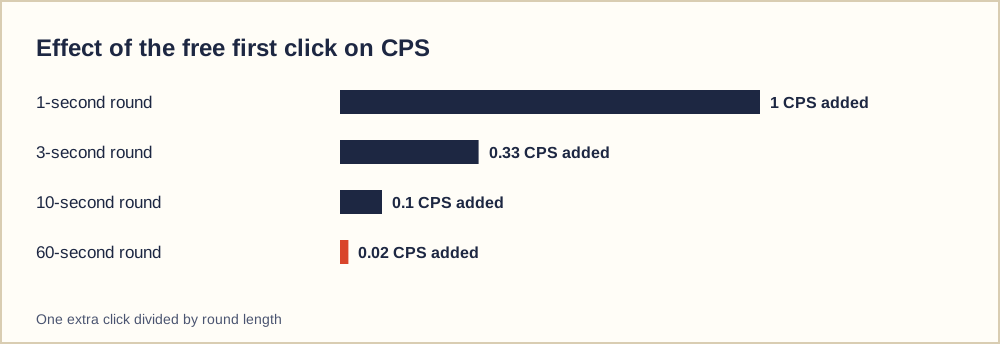
Starting on the first click has a small side effect. The first click is part of the count, but the time before it is not, so very short rounds slightly flatter you. In a one-second round, that first "free" click can be worth almost a whole CPS.
Why short rounds give bigger numbers
Anyone can sprint for a second. Your fingers start fresh, you are not yet tired, and the free first click helps. Over ten seconds, small slowdowns creep in. Over sixty seconds, forearm fatigue becomes the main limit. That is why the same person might score 11 CPS on a one-second clock, 8.5 on ten seconds and 6.5 on sixty.
| Round length | What it mostly measures |
|---|---|
| 1 second | Raw burst speed and reaction |
| 5 seconds | Burst speed with a little consistency |
| 10 seconds | The common benchmark; speed plus control |
| 30 to 60 seconds | Stamina and relaxed technique |
When you compare scores with friends or with numbers quoted online, check the round length first. A 14 CPS score on a one-second clock and a 14 CPS score over ten seconds are very different achievements.
Which presses count?
A test has to decide what a valid press is. On MouseTally the CPS dial counts presses that land on the dial with the correct button. The right-click test ignores the left button, the spacebar counter ignores held keys that auto-repeat, and the double-click test only scores two clicks that arrive within 300 milliseconds of each other.
These rules matter because browsers report more than you might expect. Holding a key down makes the operating system send repeated key events, so a test that counted every event would let you "score" by simply holding the spacebar. Filtering those out keeps the number honest.
Rounding and display
Most tests show CPS to one or two decimal places. A difference of 0.1 CPS over ten seconds is a single click, so do not read too much into tiny changes between rounds. Look at your average over several attempts instead. The tally sheet on each test keeps your recent rounds for exactly this reason.
Your hardware is part of the measurement
Every test measures the whole chain: finger, mouse switch, mouse firmware, USB connection, operating system and browser. The mouse applies a short debounce delay so one press is not read as two, and that delay sets a ceiling on how fast clicks can register. Our guide to debounce time explains why two people with identical technique can get different scores on different mice.
The browser adds very little. Modern browsers timestamp input events precisely, so the difference between browsers is usually far smaller than the difference between two attempts by the same person.
For a fair comparison
- Use the same round length every time
- Use the same mouse and surface
- Warm up with one or two easy rounds
- Compare averages, not single best rounds
- Note the technique you used
Getting a reliable personal benchmark
Pick one clock, ten seconds is the usual choice, and do three rounds after a short warm-up. Write down the middle score rather than the best one. Repeat that once a week. After a month you will have a clear picture of whether practice is helping, which is far more useful than chasing a single lucky number.
Common questions
Why is my score higher on some websites?
Some sites start the timer on page load, some count every mouse event including bounces, and some round differently. Compare like with like: same site, same round length.
Is a higher CPS always better?
For click tests, yes. In games it depends. Many games limit how often a click can register, and accuracy usually matters more than raw speed.